
Why You?
A Response to Something That Made Me Feel Slightly Dumber and Much Wiser

My writing friend Gail and I have a small, somewhat nerdy tradition.
Most Sundays, we read a newsletter from The Marginalian, written by Maria Popova, who somehow combines philosophy, poetry, physics, and the occasional 19th-century thinker into something that makes your brain feel both smarter and slightly overwhelmed.
Then we text about it like two people who snuck into a graduate seminar full of people with very strong opinions about very smart things and if the word snuck should ever be used.
Recently, Gail threw out a friendly challenge:
“You should write a response to one of her essays.”
Ha. Writing a response to Maria Popova feels a little like being asked to jam in your garage with Bruce Springsteen. Possible? Technically. Humbling? Absolutely.
But one piece—Why You?—has been circling my brain for weeks like a student who refuses to drop the class.
Popova explores the idea that our lives are built from an incomprehensible chain of accidents. Atoms bonding this way instead of that way. Your parents meeting each other. Time, place, and culture shaping the person who eventually calls themselves me.
Change any one of those variables, even slightly, and the person living your life wouldn’t be you at all.
I haven’t been able to shake that idea. It’s so random. And makes me feel so helpless.
Because my own story—the one I thought I was supposed to live—has changed in ways I never would have predicted.
When I was 16, during the Blizzard of 1996, I broke a bone in my foot. At the time, it felt like bad timing. A season interrupted. A plan derailed.
What I didn’t know was that this small fracture would eventually lead me to meet my wife, change the trajectory of our lives, and contribute to the world gaining three remarkable human beings.
That’s the fragile architecture of a life. One small shift, and everything rearranges.
For most of my life, I carried a traditional story of what it means to be a man. Be strong. Be capable. Take care of people. Handle problems. Carry the weight when it’s your turn.
Then my body started making edits.
A neurological disorder in my cerebellum began rewriting the script. Balance became uncertain. Speech became effortful. Independence became… complicated.
Roles I had quietly assigned to manhood were no longer available to me. And when that happens, you’re left with a question: If the script changes… who are you?
Popova’s idea about the randomness of the self stops being abstract. It becomes personal. Because the truth is, I didn’t choose this body any more than I chose the one I had before.
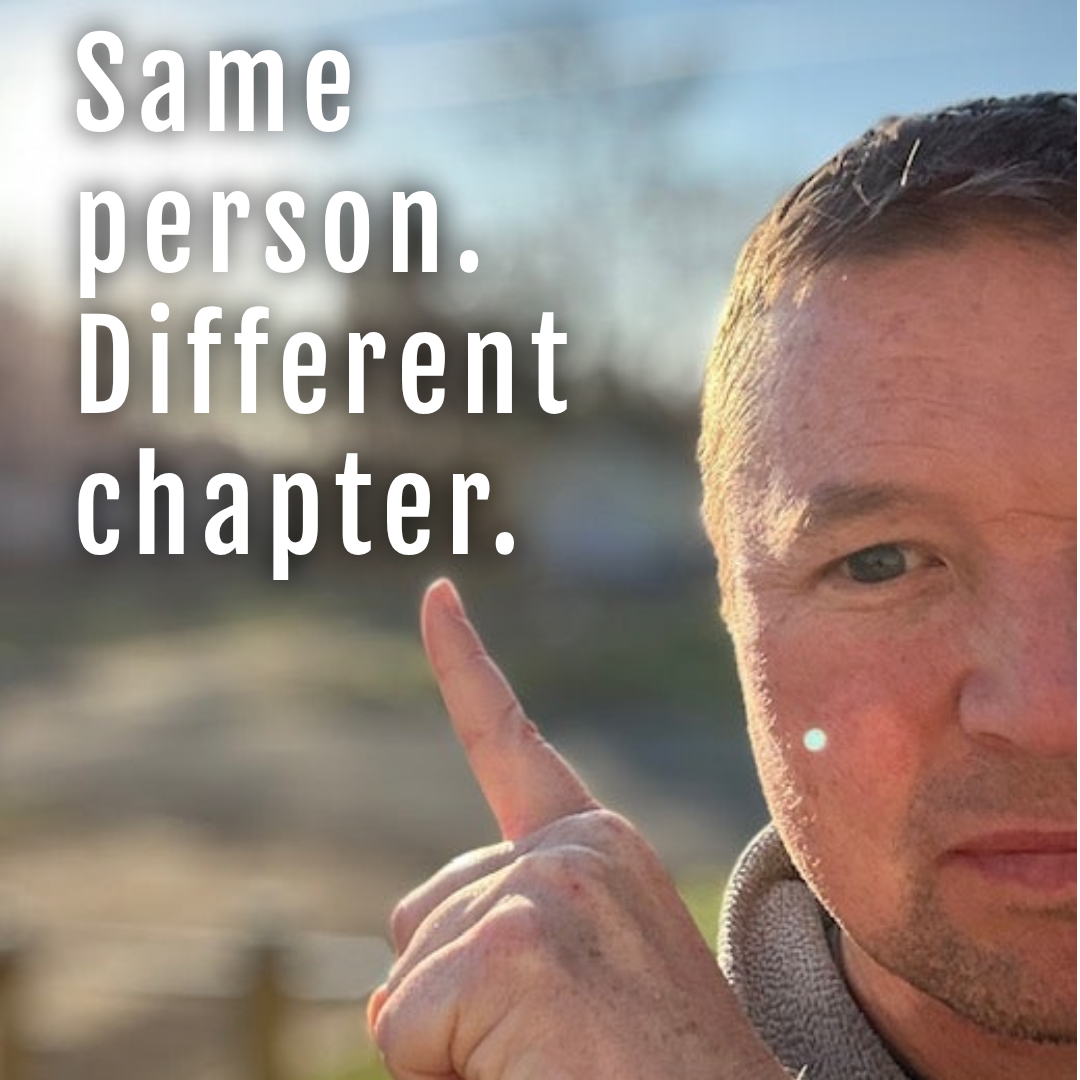
Same person. Different chapter.
What keeps drawing Gail and me back to Popova’s work is how she zooms the lens all the way out—past routines, frustrations, and identities—until we’re staring at something much bigger.
Billions of years. Stars forming. Stars collapsing. Chemistry slowly becoming life.
And then somehow… us.
Brief collections of atoms with opinions about politics, coffee, and very specific ideas about how our lives are supposed to go. From that distance, it’s harder to cling to the definitions we once thought were permanent.
My understanding of manhood has shifted. It’s less about strength and more about patience. Less about independence and more about interdependence. Less about control and more about living honestly in the life I have.
And eventually, Popova lands somewhere unexpected. Not in theory. Not in probability. Something simpler: Love.
Love of truth. Love of beauty. Love of the people sharing this wildly improbable moment with us.
Because sometimes love doesn’t begin with a grand plan. Sometimes it starts with a 16-year-old kid in the Blizzard of 1996 who took a seemingly wrong step.
A step that leads, over time, to a woman he will love, a life he never imagined, and three people who will carry that moment forward in ways he’ll never fully understand.
Maybe that’s the point.
Even if existence is built on chance, it still somehow gives rise to consciousness, memory, longing—and love. And in that, I feel a little less helpless. Like I still have a say in the parts that matter. Like my life isn’t just a some great experiment.
I don’t know if that answers why we’re here. But it’s the answer that makes the most sense to me right now. Because if the universe hands you a story you didn’t expect…
a body you didn’t choose… a life that doesn’t match the plan… maybe the work is to live it with a sense of wonder and to love the people in it as well as you can.
Because if being you is one of the most improbable things in the universe… sometimes it only takes one step in the snow to change everything.

Every year, when Daylight Saving Time rolls around, I think about the scheduled theft of one hour of my life.
This year I happened to be far from home, deep in Virginia, staying at an Airbnb for my son’s soccer tournament. A strange place to lose an hour of your life, but perhaps the perfect setting for a sleepless night.
The calendar warns me. The news reminds me. My phone sends a polite memo. And yet when the moment arrives, I resist it the way a four-year-old resists bedtime—irrationally, stubbornly, and with the quiet belief that maybe this year the clock will finally change its mind.
It never does.
So instead of going to bed, I watched one of my favorite movies: Planes, Trains and Automobiles. Again. For probably the twelfth time.
CLICK AND READ THE REST ABOUT MY RESTLESS DAYLIGHT SAVINGS NIGHT….
Jay Armstrong is an award-winning author and speaker who refuses to be defined by his diagnosis of a rare neurological disease. Despite challenges with movement, balance, eyesight, and speech, Jay continues to press forward with determination, humor, and hope. As the leader of the Philadelphia Ataxia Support Group, he’s dedicated to helping others find joy, peace, and meaning in their lives, no matter the obstacles they face.
Dear Nerd,
You just took my breath away. Your writing just gets better and better!
Thank you for so openly sharing your beautiful mind with me and your readers.
And if you want to dance with this idea through fiction… there’s a book titled The Midnight Library by Matt Haig. V. Good.
Affectionately,
Your Fellow Nerd
😂
I love that you and Gail have this Sunday routine. You are both philosophers at heart!